Rumi's Reed Flute: The Cry of the Soul Separated from God
The Reed That Remembers Its Garden
Among the great opening gestures of world literature, few carry the emotional and philosophical weight of the first eighteen verses of Jalal al-Din Rumi’s Masnavi-ye Ma’navi. Rumi (1207 to 1273 CE) composed this six-volume masterwork over the final decades of his life, and its opening image has captivated readers across continents and centuries. That image is the nay, the Persian reed flute, and its cry is not merely a poetic ornament. It is the sound of every human heart that has ever felt estranged from its true home.
The Opening Invitation
The Masnavi begins with a command: listen.
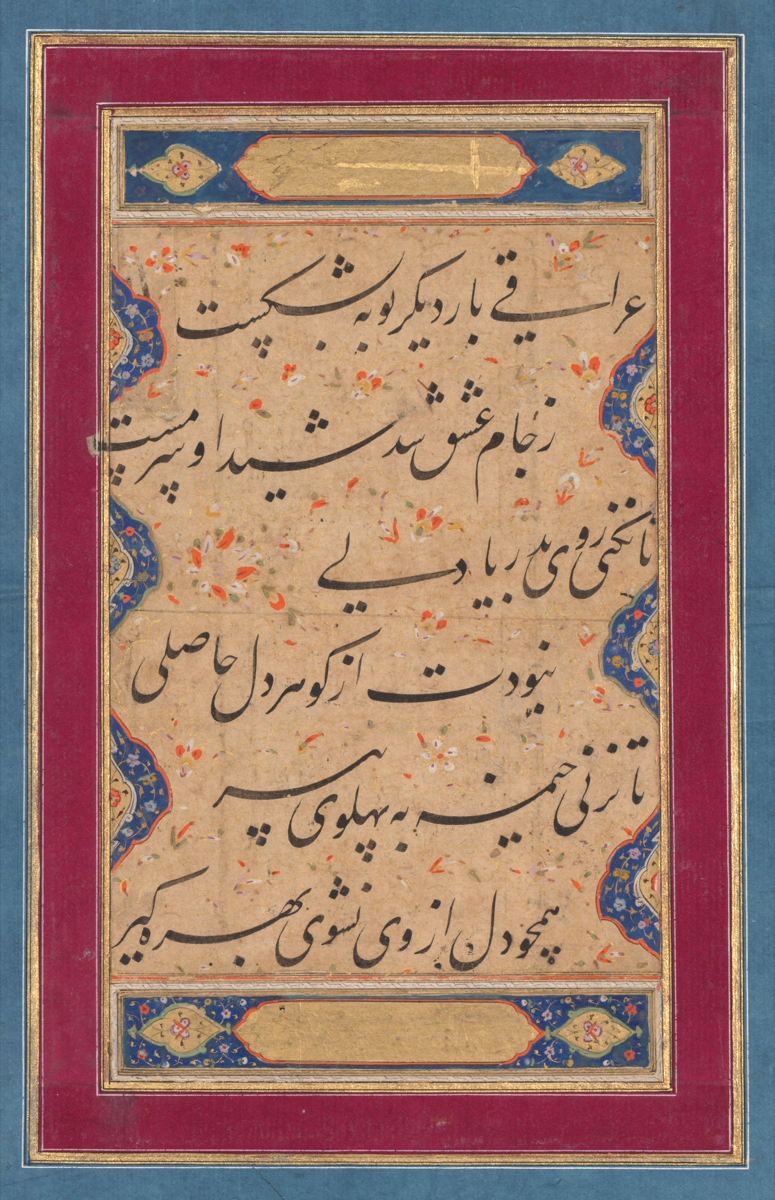
بشنو این نی چون شکایت میکند از جداییها حکایت میکند
Listen to this reed, how it tells of separations, how it narrates the stories of all partings.
The imperative “beshno” (listen) is not accidental. Rumi understood that spiritual awakening begins not with speaking but with receiving. Before any doctrine, before any argument, there must be an act of genuine attention. The reader must open themselves to what follows. And what follows is a shikayat, a formal complaint or grievance lodged by the reed against the fate that has separated it from its origin.
The nay was cut from the neystan, the reed bed or reed grove that was its original home. This physical fact of the instrument’s manufacture becomes, in Rumi’s hands, the master metaphor for the human condition. We were once part of something whole and undivided. We were cut from it at the moment of birth into earthly existence. And ever since, we have been crying.
The Universal Lamentation
What makes the opening so remarkable is its insistence on universality. The reed does not mourn privately or in secret:
کز نیستان تا مرا ببریدهاند در نفیرم مرد و زن نالیدهاند
Since they cut me from the reed bed, men and women have wept at my lament.
The music of the separated reed does not leave its listeners untouched. Men and women (mard o zan), across all human categories and conditions, respond to the nay’s song with tears. Rumi is asserting that the longing expressed by the reed is not a personal quirk of the mystic or the philosopher. It is the hidden condition of all human beings, who sense, however dimly, that they too have been cut from something essential.
This is a profound claim about the nature of aesthetic experience itself. When music moves us to tears, Rumi suggests, we are not simply responding to the technical arrangement of sounds. We are recognizing ourselves. We are hearing our own separation narrated back to us in a form that makes it bearable. The encounter with beauty, for Rumi, is a form of spiritual memory.
The Anatomy of Longing
Rumi does not romanticize the pain of separation. He describes it with searing, almost physical directness:
سینه خواهم شرحه شرحه از فراق تا بگویم شرح درد اشتیاق
I want a chest torn to shreds by separation, so that I may fully speak the pain of yearning.
The phrase “sharheh sharheh” suggests not a gentle ache but an active, ongoing wound. The sineh (chest), in Persian poetic tradition, is the seat of emotion and inner life. A chest torn to pieces by firaq (separation) is a self that has been utterly marked by absence. And yet Rumi does not seek to avoid this condition. He desires it, because only from within such anguish can he find the language adequate to describe what longing truly is.
This is perhaps the most counterintuitive dimension of Rumi’s spiritual vision: suffering, when it arises from genuine love and is directed toward the divine, is not merely acceptable but generative. Firaq is the price the soul pays for the possibility of eventual wisal (union). The torn chest is the condition for authentic speech about love. One cannot speak from a distance one has never felt.
Love as Elemental Fire
The fourth verse from the opening introduces the elemental force that drives the entire Masnavi forward:
آتش عشق است کاندر نی فتاد جوشش عشق است کاندر می فتاد
It is the fire of love that fell into the reed, it is the ferment of love that fell into the wine.
Here love is not a sentiment or an emotional state. It is an atash, a fire that falls into things and transforms their essential nature. The reed was just a plant growing in a marsh until the fire of love fell into it. Then it became a vehicle for the most penetrating music humanity has ever known. The wine (may) was just a liquid until the ferment of love fell into it. Then it became the great metaphor for spiritual intoxication and illumination.
This image of fire descending into created things is central to Rumi’s understanding of the cosmos. The divine is not a remote, unmoved principle contemplating itself in serene detachment. The divine is active, descending, igniting, transforming. Creation is not abandoned matter left to its own devices. It is matter that has been touched by love. And the proof of this touch is the music: things cry because they have been loved, and because they long to return to the source of that love.
From Personal Grief to Universal Truth
It would be incomplete to read the Masnavi’s opening without noting its biographical context. Rumi encountered Shams-i-Tabrizi in Konya in 1244 CE, and the relationship between the established scholar and the wandering mystic was one of the most electrifying spiritual partnerships in recorded history. When Shams disappeared around 1248 CE (and was likely killed by jealous members of Rumi’s circle), Rumi was devastated in a way that reshaped his entire life and art.
The Divan-e Shams (also called the Divan-e Kabir), the collection of lyric poems Rumi composed in his teacher’s name, expresses this personal grief in an almost unbearable register. But the Masnavi, begun some years later under the guidance of his disciple Husam al-Din Chalabi, performs a remarkable transformation. Personal grief is not abandoned or suppressed. It is universalized. The wound of losing Shams becomes the wound that all souls carry in their separation from the divine.
This is one of the deepest functions of great poetry in any tradition: to transfigure private experience into shared wisdom. Rumi does not overcome his grief by setting it aside. He overcomes it by expanding it until it contains all grief, all separation, all longing. The specific, time-bound loss of one man for his teacher becomes the timeless longing of the created for the Creator. The personal wound, held with enough love and sustained attention, becomes a door through which universal truth enters.
The Concept of Home
The concept of asl (origin, root, or source) is fundamental to understanding what the nay metaphor ultimately means. In Rumi’s cosmology, every created being has an origin in the divine, and the condition of earthly life is a form of exile from that origin. The soul did not begin here, in the world of forms and change. It comes from a place of wholeness and undivided light, and it carries within itself a memory of that place, however faint or buried beneath the noise of ordinary life.
The reed bed is that place. It is the original garden from which each individual reed was cut. The nay is beautiful, musical, and capable of extraordinary expression precisely because of its hollow wound. But it knows, in some register deeper than thought, that it was once part of a greater whole. And it will not be silent about this knowledge.
What is most striking in Rumi’s treatment is that separation is not presented as a problem to be solved but as a condition to be inhabited with full awareness and full acceptance. The seeker who knows they are separated is already oriented toward home. The grief itself is a form of direction. One cannot long for a place one has never known. The very capacity to feel hijr (separation, exile) is evidence that the soul remembers, however obscurely, its divine origin.
Grace Found in Exile
Two verses from the Masnavi that follow the famous opening capture the posture of the seeker who has learned to dwell in separation without bitterness:
چون به خویش آمد ز غرقاب فنا خوش زبان بگشاد در مدح و دعا
When he came to himself from the whirlpool of annihilation, he opened his lips sweetly in praise and prayer.
The movement here is instructive: annihilation (fana) precedes self-recovery, and self-recovery precedes praise. The seeker does not praise God despite having been submerged. The submersion is the condition for the praise. The whirlpool of fana, terrifying as it is, is what teaches the tongue the real language of gratitude.
از خدا جوییم توفیق ادب بیادب محروم گشت از لطف رب
From God we seek the grace of proper conduct, for the one lacking it is barred from the Lord’s kindness.
Adab (proper conduct, courtesy, inner alignment) is the spiritual posture of the one who has understood what separation means. It is not passive resignation. It is an active orientation of the whole self toward the source of love, a recognition that the longing one feels is itself a form of divine attention paid to the soul. The separated reed, if it holds its wound with the right inner stance, becomes the most eloquent thing in creation.
The Reed as the Poem Itself
The Masnavi as a whole can be understood as one extended attempt to speak the “sharheh dard-e eshtiyaq” (the full account of the pain of longing) announced in those opening lines. Everything that follows in the six volumes, the stories and parables, the theological discourses, the sudden lyric passages of pure devotion, can be read as Rumi’s effort to honor the promise made at the very beginning.
The nay is not merely a subject of the poem. It is the model for the poem’s existence. The Masnavi cries because it is separated. It cries because only in crying can it point toward reunion. And it cries with the hope that its listeners, hearing their own hidden separation narrated back to them, will be moved to begin their own journey toward the reed bed that was their first home.
In the long tradition of Persian Sufi poetry, which runs from Sanai and Attar through Rumi himself and on to Hafez and Jami, few images have proven as enduring or as generative as this one. The reed’s music begins in wound and exile and ends, if the listener truly hears, in the first trembling recognition of the way home.