The Qasida: Persian Ode and the Masters of Formal Praise
The Qasida: Monument and Occasion
If the rubai is a jewel, the qasida is a cathedral. Where the quatrain accomplishes its art in four lines, the qasida deploys twenty, fifty, sometimes a hundred or more couplets in a single sustained monorrhyme. It is the most architecturally complex form in classical Persian poetry, and for six centuries it was unquestionably the most prestigious.
To write a successful qasida required technical command that bordered on the athletic: sustaining a single rhyme across dozens of couplets demanded an extraordinary vocabulary and an equally extraordinary ear. The poets who mastered it were celebrated in their own time as virtuosi, and their work was copied, memorized, and recited at the highest levels of courtly culture.
Form and Structure: A Four-Part Architecture
The classical qasida follows a formal structure that Persian rhetoricians codified in great detail. While individual poets varied the proportions, the four-part schema remained the standard from the 10th century through the 16th.
The poem opens with the nasib (نسیب), a lyric prelude of varying length that establishes mood. In Arabic qasidas, the nasib was often an elegy for a deserted encampment; Persian poets adapted this into a nature passage, describing the arrival of spring, a winter scene, the beauty of a garden, or (in amatory qasidas) the appearance of the beloved. The nasib is technically unrelated to the poem’s main subject, but its emotional tone primes the audience. A master poet uses the nasib to create a lyric environment that will make the main theme more resonant.
The transition section (takhallus, تخلص) connects the prelude to the main theme. In praise qasidas, this is often a sharp pivot: from the beauty of a garden to the greater beauty of the patron’s character, from descriptions of dawn to the radiance of the king’s court. This pivot needed to be smooth and witty: a clumsy transition was a mark of a lesser poet.
The maqsad (مقصد), or main section, constitutes the bulk of the poem. In a panegyric (madh, مدح), this is extended praise of the poem’s subject: a king, a minister, a military commander, or a religious figure. Persian panegyric was a highly conventionalized art. The poet was expected to praise specific virtues: justice, generosity, valor in battle, erudition, piety. The imagery was drawn from a shared lexicon of royalty: sun, ocean, mountain, sword, key to paradise. What distinguished a great panegyrist from a mediocre one was the freshness and precision with which he deployed these common materials.
The poem closes with the khutba (خطبه), a concluding address that often included the poet’s pen name, a prayer for the subject’s continued prosperity, and sometimes a request for a specific reward. The qasida was, among other things, a sophisticated instrument of economic exchange in a gift economy: beauty offered in return for patronage.
The Court Poets: Masters of the Form
The classical tradition of Persian qasida writing began with Rudaki of Samarkand (approximately 858 to 941 CE), whom later literary historians called the father of Persian poetry. His surviving qasidas show a natural grace and melodic beauty that set the standard for subsequent generations. The famous ode beginning “Buye Juy Muliyan” (the scent of the Mulian stream), composed to persuade the Samanid ruler Nasr II to return to Bukhara, is the archetypal political qasida: lyric beauty deployed in the service of specific practical purpose.
Manuchehri Damghani (died approximately 1040 CE) was the supreme nature poet of the form. His nasib passages describing spring mornings, wine sessions in gardens, and the beauty of natural phenomena are among the finest nature writing in any language. Manuchehri borrowed from Arabic, Greek (through Arabic transmission), and Persian folk tradition with an eclecticism that never felt forced.
Farrukhi Sistani (died approximately 1038 CE), a court poet of the Ghaznavid dynasty, perfected the panegyric at its most technically demanding. His qasidas in praise of Sultan Mahmud of Ghazni are monuments of verbal engineering: sustained for eighty or ninety couplets without the rhyme ever feeling strained, the argument never losing its forward momentum.
Anvari Abivardi (approximately 1126 to 1189 CE) was perhaps the most intellectually complex of the great qasida writers. His odes contain passages of philosophical density unusual in a courtly context, and his elegies (marsiya) are among the most moving in the language.
The Formal Prelude: Saadi’s Opening of the Bustan
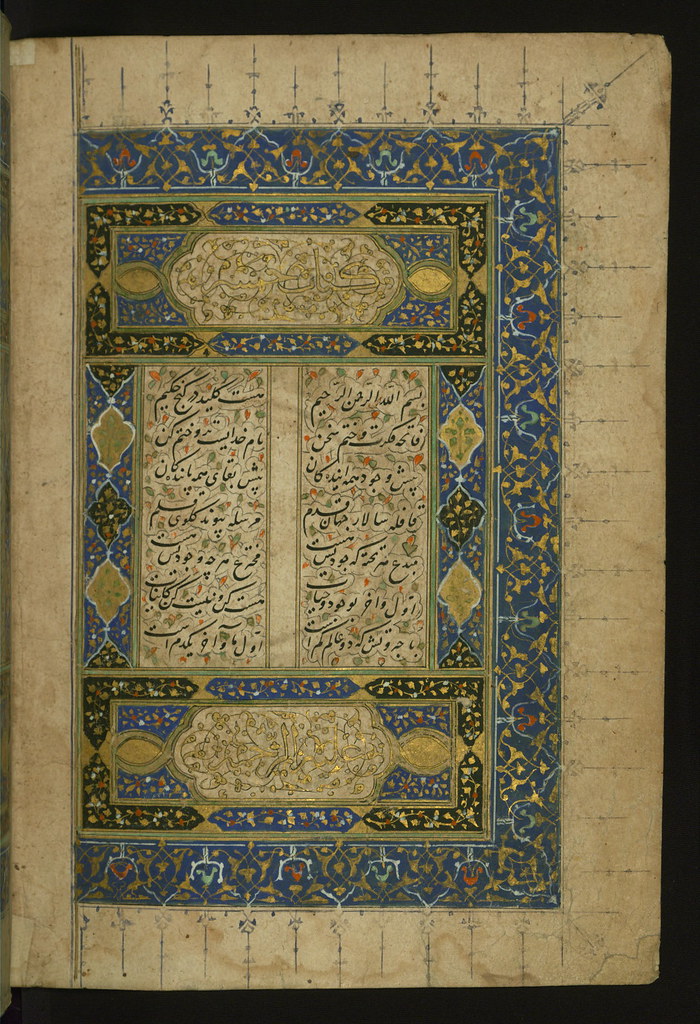
When Saadi of Shiraz composed his Bustan (“The Orchard”) in 1257 CE, he opened it with a formal eulogy whose elevated rhetoric borrows directly from the qasida’s tradition of praise. The opening lines demonstrate how the qasida’s conventions, even when deployed in a different metrical scheme, carry the weight of a long literary tradition:
به نام خداوند جان آفرین حکیم سخن در زبان آفرین
In the name of the Lord who creates the soul and gives it breath, the Wise One who plants speech upon the tongue before our death.
کریم السجایا جمیل الشیم نبی البرایا شفیع الامم
Generous of character, beautiful of manner and of way, prophet to all creation, intercessor on the final day.
امام رسل، پیشوای سبیل امین خدا، مهبط جبرئیل
Leader of all messengers, guide upon the righteous path alone, the trusted one of God, the landing-place where Gabriel has flown.
These three couplets illustrate the qasida’s praise register at its most elevated. The subject here is the Prophet Muhammad, and Saadi deploys Arabic honorifics (karim al-saja’ya, generous of character; nabi al-bara’ya, prophet to creation) embedded within Persian syntax, a technique the great qasida poets used to signal erudition and cultural authority. The density of the honorifics, each couplet adding a new attribute, is structurally identical to the qasida’s panegyric method: the poem advances through accumulation rather than narrative.
What is notable in Saadi’s opening is also the formality of address. The tone is not intimate; it is ceremonial. This is the defining quality of the qasida that distinguishes it from all other Persian forms: the qasida speaks from a public podium, while the ghazal speaks from a private chamber.
Compare the rhetorical register of Saadi’s formal praise with a quatrain by Omar Khayyam:
چون عهده نمیشود کسی فردا را حالی خوش دار این دل پر سودا را می نوش به ماهتاب ای ماه که ماه بسیار بتابد و نیابد ما را
Since no one can stand surety for tomorrow’s dawn, keep this troubled heart at ease before the light is gone. Drink wine by moonlight, for the moon will many ages shine across a sky that finds us here no longer, in time.
The contrast is immediate. Where Saadi’s praise poem accumulates honorifics in a voice designed to be heard in a hall, Khayyam’s rubai whispers in the ear. This difference of register, public versus intimate, formal versus confessional, is the sharpest line between the qasida and all shorter Persian forms.
The Qasida in Mystical Poetry: Sanai and Rumi
The qasida’s prestige made it attractive to poets who wished to invest their message with authority. From the 12th century onward, Sufi poets began appropriating the form for mystical content, replacing the earthly patron with the divine beloved and the praise of a king’s sword with praise of God’s unknowable essence.
Sanai Ghaznavi (approximately 1080 to 1131 CE), the first great Sufi poet to systematically use Persian forms for mystical purposes, composed qasidas of remarkable austerity. His zuhdiyya (ascetic qasidas) borrow the formal machinery of panegyric and direct it toward self-examination and renunciation of worldly ambition. Sanai’s qasidas were enormously influential: Attar read them, and Rumi read Attar.
Rumi himself composed qasidas within his Divan-e Shams, though his more characteristic forms were the ghazal (which he transformed radically) and the masnavi. His qasidas show the tension between the form’s public register and his essentially ecstatic, personal voice. Where a court poet aimed at rhetorical grandeur, Rumi aimed at spiritual ignition, and the friction between those two aims gives his qasidas an energy his predecessors never achieved.
Qasida versus Ghazal: Public and Private
The relationship between the qasida and the ghazal is one of the central tensions in classical Persian literary history. The ghazal began as a kind of amatory prelude, the nasib of the qasida detached and developed independently, and gradually evolved into an independent form of great prestige. By the 13th century, with Saadi’s and then Hafez’s mastery of the ghazal, the shorter form had begun to displace the qasida at the center of Persian literary culture.
The reasons are structural as well as cultural. The ghazal’s intimacy suited the Sufi sensibility; its shorter length made it more easily memorized and sung; its conventions of the beloved (ambiguously human or divine) gave it spiritual flexibility that the qasida’s public rhetoric could not match. As courtly patronage weakened with the Mongol invasions of the 13th century, the social occasion that gave the qasida its function also weakened.
The qasida did not disappear: it continued to be composed and admired through the Safavid period and beyond. But it gradually ceded its position as the form that defined a poet’s greatness to the ghazal, and from the ghazal, eventually, to the masnavi.
Sub-genres: More Than Just Praise
It is worth noting that the qasida was never solely an instrument of royal flattery. Persian literary critics identified several distinct sub-genres. The madh (مدح) was pure praise, but alongside it stood the marsiya (مرثیه), the elegy for a fallen figure or lost era; the zuhdiyya (زهدیه), the ascetic poem counseling detachment from the world; the fakhriyya (فخریه), the poem of self-praise in which the poet celebrates his own craft; and the hajv (هجو), the satirical attack. Each sub-genre had its own conventions of imagery and argument, and a master poet was expected to move between them with ease.
The fakhriyya passages in particular reveal something important about the social position of the qasida poet: these were not merely hired pens but craftsmen with a professional pride and a public identity. A poet who could compose a devastating hajv held real social power; a patron who angered a poet of Anvari’s stature could expect to be satirized before the entire court.
Legacy: The Qasida as Measure of Mastery
For any student of classical Persian poetry, the qasida remains indispensable. The form is where the language’s technical resources were most fully deployed: the longest sustained rhymes, the most complex prosodic patterns, the widest range of rhetorical figures. A poet who could write qasidas was a poet who had mastered the tradition.
Modern Persian literary culture has largely moved away from the qasida (as from all classical forms), but the form retains its prestige as a measure of historical scholarship and technical understanding. To read Anvari’s great political odes, or Khaqani’s celebrated prison qasida (in which he describes his imprisonment with images of devastating psychological depth), is to encounter a form of literary ambition that no shorter poem can quite contain.
The cathedral still stands. Whether we still hold services in it is another question entirely.